Franchise GBP Management: Best Practices for Multi-Location Brands
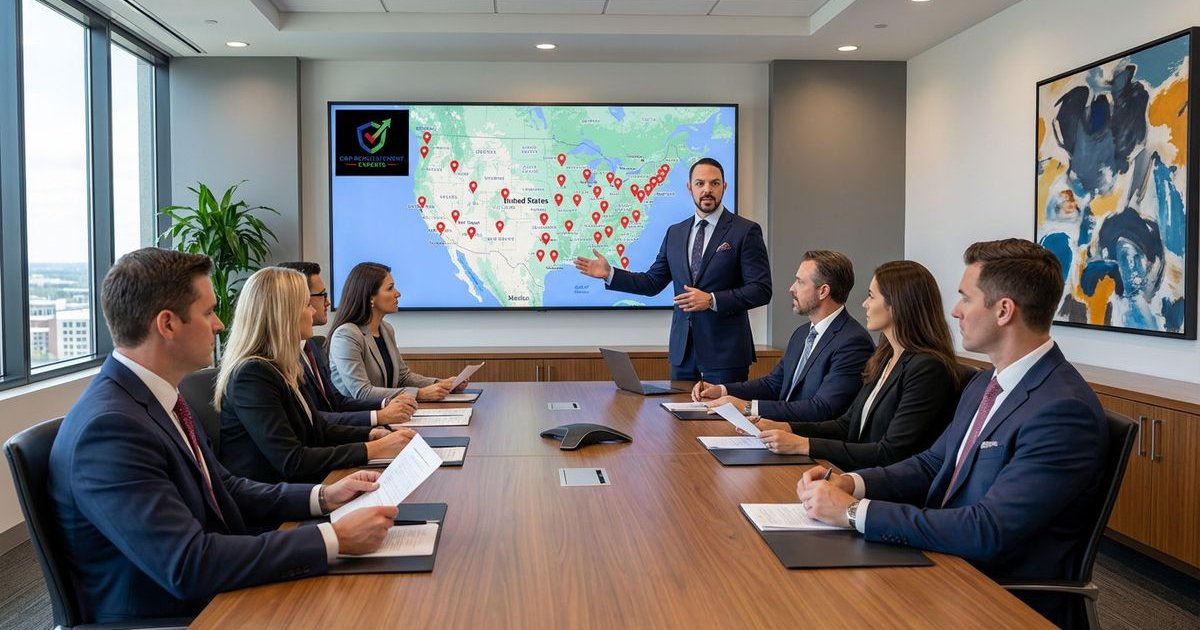
Franchise systems present unique GBP management challenges. Our multi-location advisory team specializes in helping brands navigate this complexity.
Balancing brand consistency with local relevance requires a careful strategy.
We often see brands paralyzed by systematic suspensions because they lack this balance.
Most multi-location businesses struggle to keep data accurate across dozens or hundreds of listings.
Our team has spent years refining the protocols that prevent these widespread errors.
Let’s look at the specific data, the management models that actually work, and the exact recovery steps you need.
Franchise-Specific Challenges
Ownership Complexity
Franchises involve a tangled web of stakeholders.
Corporate oversight needs often clash with local operational realities.
We frequently encounter confusion regarding who actually “owns” the pin on the map.
Franchisees usually want control to post updates or change hours instantly.
Multiple people with legitimate interest in the listing can trigger security flags with Google.
Varying technical capabilities among franchise owners create data quality gaps.
Brand Consistency vs. Local Autonomy
There is a constant tension in this ecosystem.
Maintaining brand standards ensures the customer recognizes the experience before they walk in.
We know that Google rewards consistency, yet local customization drives engagement.
Preventing unauthorized changes, like a rogue franchisee adding “Best Pizza” to their business name, is critical for compliance.
Enabling responsive local management is equally important for customer service.
Scale Complications
As networks grow, the margin for error shrinks.
Management complexity increases exponentially once you pass the 10-location mark.
We see consistency become harder to enforce without enterprise-grade software.
Risk of cascade issues rises, where one suspended listing triggers a review of the entire account group.
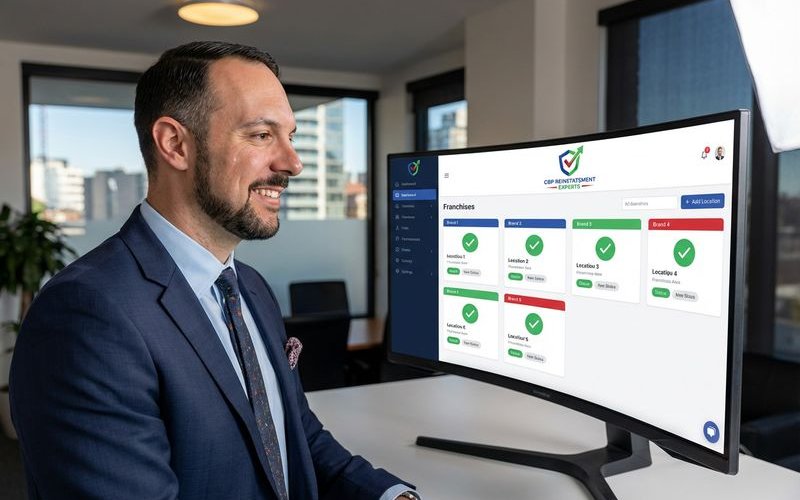
Oversight becomes challenging without a centralized dashboard.
Management Structure
Choosing the right control model is the most important decision you will make.
The “set it and forget it” approach does not work in the current US search environment.
We advise clients to evaluate these three structures based on their internal resources and budget.
Ownership Model Options
Option 1: Corporate-owned profiles
- Corporate owns all GBP listings: The headquarters retains primary ownership rights.
- Franchisees have limited/no direct access: Local owners must submit tickets for changes.
- Changes go through corporate: This creates a bottleneck but ensures 100% data purity.
- Maximum control, less local responsiveness: Reviews often go unanswered for too long.
Option 2: Franchisee-owned profiles
- Each franchisee owns their GBP: The local owner claims and manages the listing directly.
- Corporate provides guidelines: Headquarters offers a PDF handbook that is often ignored.
- Less central control: This puts the brand reputation strictly in the hands of local operators.
- Risk of inconsistency: Name mismatches here frequently hurt overall domain authority.
Option 3: Hybrid model (recommended)
- Corporate owns profiles: The brand retains the “Primary Owner” status for security.
- Franchisees have user-level access: Local managers are granted “Manager” roles.
- Defined permissions for each role: Corporate locks core data (Name, Category) while locals handle dynamic data (Posts, Reviews).
- Balance of control and flexibility: This creates the best user experience and SEO performance.
Comparison of Management Models
| Feature | Corporate-Only | Franchisee-Only | Hybrid Model |
|---|---|---|---|
| Data Accuracy | High | Low | High |
| Review Response Speed | Slow (< 48 hours) | Fast (< 2 hours) | Fast (< 6 hours) |
| Suspension Risk | Low | High | Moderate |
| Local SEO Performance | Moderate | Variable | Best |
Access Levels
Properly configuring permissions prevents unauthorized takeovers.
Google provides specific roles that help segregate duties effectively.
We strictly implement the following hierarchy for all our multi-location clients.
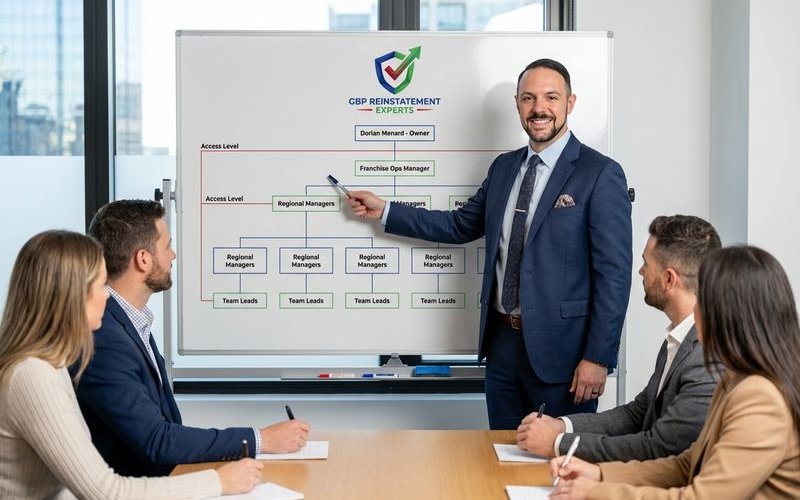
- Corporate: Owner access to all listings via an Agency Dashboard or Location Group.
- Regional managers: Manager access to specific region groups (e.g., “Northeast Locations”).
- Franchisees: Communications manager or site manager roles to handle reviews and posts.
- Local staff: Limited or no access to prevent accidental data deletion.
Brand Standards
Business Name Requirements
A consistent naming convention is your first line of defense against suspension.
Google’s “Name” field is strictly for the real-world name of the business.
We have seen entire location groups suspended for adding city names or keywords to the business title.
Establish clear rules:
- Exact name format to use: It must match the signage and legal LLC documents.
- No local modifications allowed: Franchisees cannot add “Downtown” or “24 Hours” to the title.
- How to handle DBA variations: Document these legally if they differ from the main brand.
- Exception process if needed: Only allow deviations if the physical signage is different.
Example format: “[Brand Name]” (Correct) vs. “[Brand Name] of [City]” (Incorrect, unless on signage).
Category Standards
Category selection dictates which keywords you rank for.
Inconsistency here confuses the algorithm and dilutes your relevance.
We analyze competitor categories annually to ensure our clients are indexed correctly.
Define approved categories:
- Primary category (consistent across all): Every location must use the exact same primary tag.
- Approved secondary categories: Provide a pre-vetted list of 3-5 options.
- Prohibited categories: Explicitly list categories that do not fit the brand image.
- Category change process: Lock this field so only corporate can update it.
Visual Guidelines
Images significantly impact click-through rates (CTR).
Blurry or irrelevant photos degrade the perceived quality of the franchise.
We recommend using a Digital Asset Management (DAM) system to distribute approved imagery.
Standardize across locations:
- Logo usage requirements: Ensure the profile photo is centered and formatted for a circle crop.
- Photo quality standards: High-resolution images that are well-lit and professional.
- Interior/exterior shot requirements: Google validates location existence through these photos.
- Prohibited image types: No stock photos or text-heavy graphics that violate Google’s content policy.
Operational Processes
Change Management
Uncontrolled changes destroy data integrity.
A systematic approach ensures that updates happen smoothly across the network.
We utilize API-connected platforms like Yext, SOCi, or Uberall to gate these changes.
When changes are needed:
- Request submitted through system: The franchisee submits a ticket or form.
- Corporate reviews against standards: A central brand manager verifies the request.
- Approved changes implemented centrally: The update is pushed via API or bulk upload.
- Rolled out to locations systematically: Changes propagate to Google, Apple Maps, and Bing simultaneously.
New Location Setup
Opening a new franchise location requires precise timing.
Creating the listing too early can trigger a “misrepresentation” suspension.
We advise creating the profile only when permanent signage is installed.
For new franchises:
- Corporate creates the profile: Use the bulk upload spreadsheet (CSV) for 10+ locations.
- Standard information applied: Input the Store Code, phone, and website URL immediately.
- Local details added: Specific hours and opening dates are populated.
- Verification managed centrally: Use the bulk verification request form rather than individual video verify if eligible.
- Access granted to franchisee: Invite the local owner only after the listing is live and stable.
Franchisee Transitions
Ownership changes are high-risk moments for data loss.
The outgoing owner often takes the login credentials with them if not managed correctly.
We enforce a strict “deprovisioning” protocol the day the contract ends.
When ownership changes:
- Remove outgoing franchisee access: Revoke their Google permissions immediately.
- Update any ownership documentation: Ensure the internal dashboard reflects the new contact.
- Add new franchisee access: Send the invitation to the incoming owner’s business email.
- Review compliance: Audit the listing for any unauthorized changes left behind.
- Train new owner on standards: Provide the GBP handbook during onboarding.
Compliance Monitoring
Regular Audits
You cannot fix what you do not measure.
Manual checks are impossible when you have hundreds of locations.
We lean on automated auditing tools like BrightLocal or Places Scout to scan for discrepancies.
Establish audit schedule:
- Monthly: Spot-check sample of locations (10-15%) for photo compliance.
- Quarterly: Comprehensive portfolio review including name, address, and phone (NAP) consistency.
- Annually: Full compliance audit comparing GBP data against the corporate website store locator.
Issue Response
Speed is essential when a compliance issue is detected.
A fake review attack or a hijacked listing can cause significant revenue loss within days.
We categorize issues by severity to prioritize resources effectively.
When problems are found:
- Document the issue: Take screenshots and record the date.
- Determine if systemic: Check if other locations are facing the same problem.
- Remediate immediately: Revert the changes or submit a redressal form to Google.
- Communicate to relevant parties: Inform the franchisee and the regional manager.
- Update prevention measures: Adjust the permissions or training to stop it from happening again.
Training Programs
Educated franchisees are your best assets.
They are the eyes and ears on the ground who can spot local competitors.
We develop short, actionable video modules that explain “why” compliance matters.
Educate franchisees on:
- GBP policies and requirements: Explain the “Prohibited Content” guidelines simply.
- Brand standards for profiles: Show good vs. bad examples of photos.
- Change request procedures: Make it easy for them to ask for help.
- What not to do: Explicitly warn against keyword stuffing and buying reviews.
Suspension Response Protocol
A hard suspension removes your business from Maps entirely.
This usually happens due to “Suspicious Activity” or quality guideline violations.
We treat every suspension as a critical emergency that requires a methodical response.
If locations are suspended:
- Assessment: Check the “Info” tab for recent changes that might have triggered the bot.
- Isolation: Do not edit other profiles in the same group until you understand the trigger.
- Communication: Notify affected franchisees immediately so they stop panicking.
- Resolution: Gather business licenses and utility bills, then submit the Reinstatement Form.
- Recovery: Once reinstated, review the listing to ensure reviews were restored.
- Prevention: Review the edit logs to identify the user action that caused the flag.
Franchise GBP management done right protects both brand value and local business performance. Get a free audit of your franchise portfolio to identify potential compliance gaps.
GBP Reinstatement Experts
Our team of GBP reinstatement experts has helped over 12,500 businesses recover their suspended Google Business Profiles.
Learn more about our team →